



















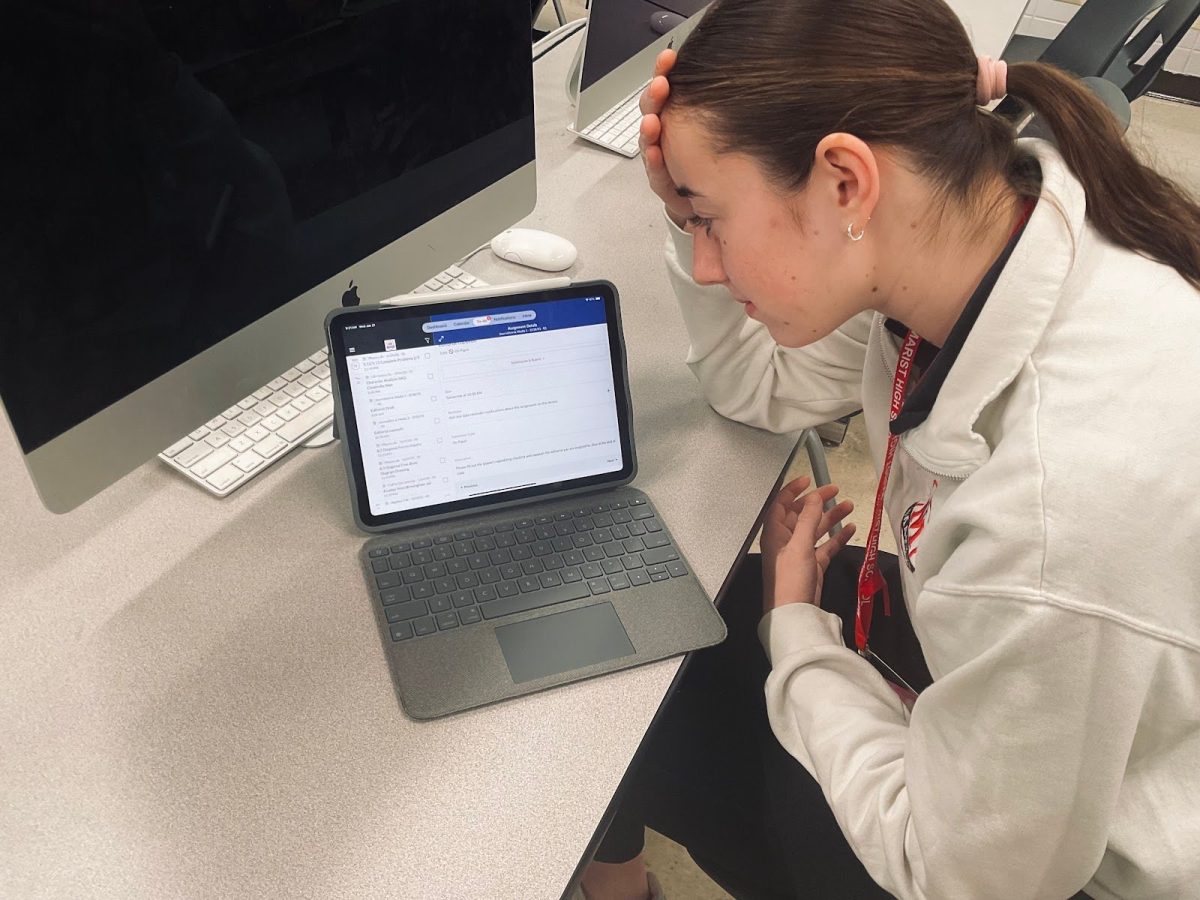

After a long school day filled with lectures, tests, and extracurricular activities, many students return home only to face another challenge – homework. While teachers argue that homework strengthens skills and builds responsibility, students often describe it as overwhelming and stressful. The debate over homework has existed for decades, raising the question: hy do teachers continue to assign it despite student frustration?
For freshman Kasey Peña, homework feels like more like a burden than extra practice.
“Homework after a long school day puts so much pressure on me and it really makes me feel stressed out, especially because I’m in extracurriculars,” Peña said.
Like many students, Peña balances academics with activities outside of the classroom. Weekend homework often interferes with family time and sports.
“That’s my only free period or my only chance to do things of my family and my friends, but sometimes I can’t even do that because of the amount of homework we get,” she said.
Peña believes homework can have benefits, but the amount often outweighs the positives.
“I do think there are some benefits from homework, but I think that the amount of it just makes students not want to do it and pushes them back from finishing, ” she said.
If Peña could change one thing, she would reduce the amount of homework and focus on quality instead.
Peña says, “If teachers are going to give out homework, they shouldn’t do so many questions but only a couple good questions that will prepare students for test rather than 40 pointless questions.”
However, math teacher Elizabeth Chlebek sees homework from a different perspective. Chlebek believes homework is necessary to reinforce learning that begins in the classroom.
“Homework is essential for strengthening skills that you would not know how to do without the practice. Especially if a student doesn’t grasp the material immediately, they need to take the time to practice,” Chlebek says.
With limited class time, Chlebek often relies on homework to ensure students fully understand a topic before moving on.
“I hope students gain confidence in the material by practicing, since there’s not enough class time to practice,” Chlebek says.
Chlebek also recognizes that students have different academic needs.
“One student may only need 10 problems where another needs 40,” Chlebek said. “At the same time, it is not realistic to make individual assignments for every student and it is better to have more practice than not enough.”
While students argue that homework affects motivation, Chlebek believes it prepares students for real-world responsibilities.
“I think students need to learn how to manage their time and take stressful moments and learn from them,” she said. “Life is stressful in general.”
Peña strongly disagrees.
“Homework affects my motivation for school so much because sometimes I can come home with 13 homework assignments and my grade will drop if I don’t do a single one,” she said.
In one sentence, she described homework in her life as “extremely stressful and makes me sad.”
Despite their differences, both perspectives share one common goal: student success. The conversation surrounding homework may not end anytime soon, but open communication between students and teachers could help bridge the gap. Regardless of how it is perceived, homework continues to shape students’ daily lives long after the final school bell rings.