






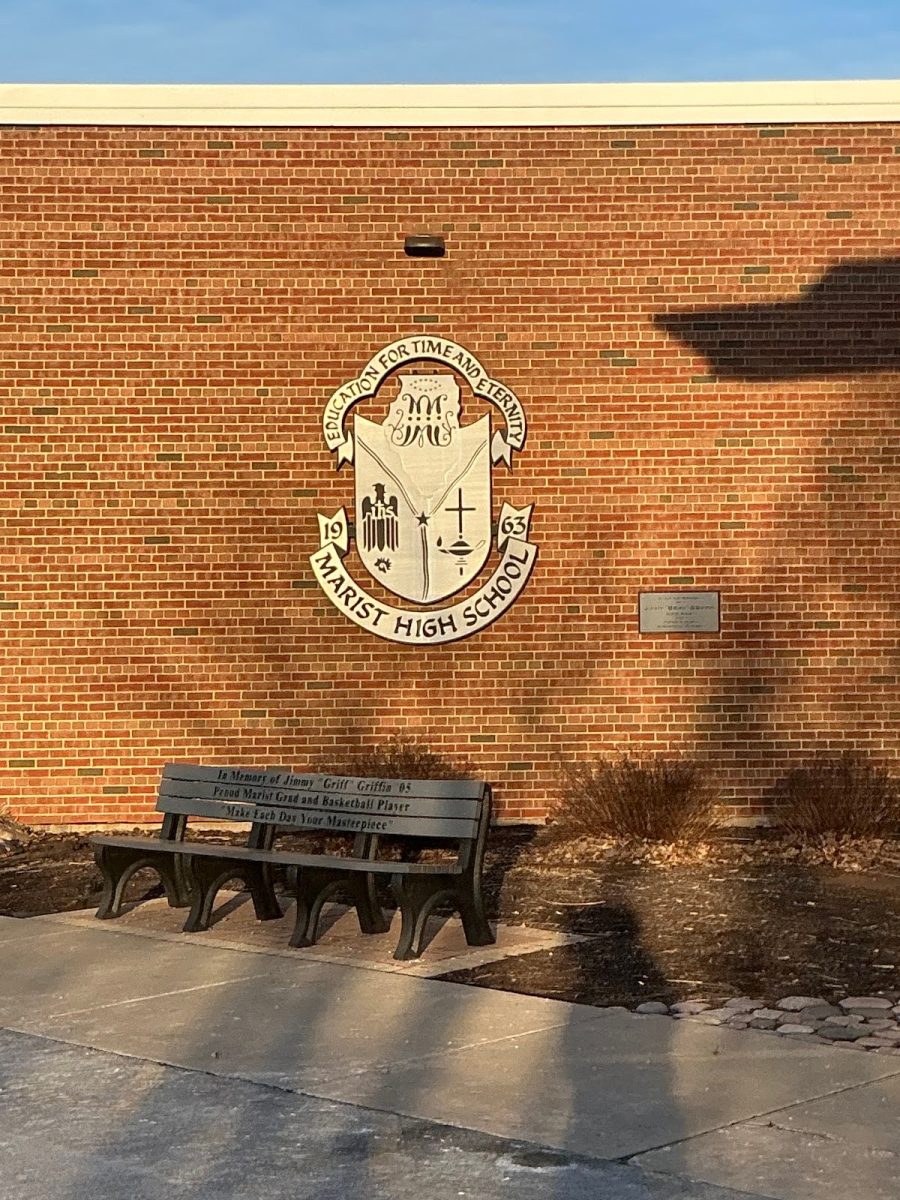
Ever since its doors opened in 1963, Marist High School’s mission has been to prepare students for college and beyond through faith and academics. “Education for time and eternity” has always been Marist’s motto, but what goes into making this statement a reality?
“We want [students] to be able to get through their four years at Marist and then open the doors to a couple of colleges they want to go to, or trade schools, or the military, or said next step,” says Principal Meg Dunneback.
Every path to success has a beginning, and high school is no exception.
“When students come in freshman year, they come from so many different places, that our job as freshman teachers is to get them closer to the same range,” says English teacher Megan Scanlon. “When you have a common language that’s established as freshmen, then when those students become seniors, you can use that language to say, ‘This is how we’re gonna get to the next step.’”
To individualize the learning process, Marist provides four curriculum tracks: academic, honors, AP (Advanced Placement), and the Marcellin program. As students grow confident in their academic abilities, they are encouraged to take more rigorous courses.
“Students in higher level classes should expect the work to be more challenging and may need to dedicate additional time to studying, seeking clarification, and attending tutoring,” says Dean of Student Success Joy Lewis. “However, needing extra support does not mean they do not belong. Embracing that challenge, and using the available resources, is part of the growth process.”
The 22 AP courses offered at Marist allow RedHawks to experience the same academic rigor they will encounter in college. All students who enroll in an AP class are required to sit for the AP Exam in May, and if they earn a score of at least three, college credit can be obtained.
“Imagine taking a college-level course, and knowing how hard or challenging or how rewarding it is, but being able to do it in the setting of your high school where you’re feeling comfortable,” says Dunneback.
Although AP courses strengthen academic discipline, a heavy workload can quickly cause exhaustion. Consequently, a cap is placed on how many AP classes a student can take per year. Freshmen are allowed only one AP; sophomores, two; juniors, three; and seniors, four.
“There’s that balance,” says Dunneback. “Things like sleep and nutrition actually matter in a teenager’s life.”
College credit can also be earned through dual-credit courses.
Marist offers 15 dual-credit courses partnering with Loyola University, Benedictine University, and Saint Xavier University. These courses save educational expenses, help students stand out in the college application process, and provide career guidance.
Another attribute of Marist that aids in career exploration includes the variety of electives.
These courses introduce students to career paths by allowing them to explore personal interests and gain a clearer sense of their strengths and weaknesses. Electives also increase engagement — a critical factor in student achievement.
“I think learning is enhanced immensely when you want to be in the room,” says Dunneback.
Teachers at Marist certainly inspire students to be in those rooms.
“I used to be very uncomfortable with just lecturing, and I realized that students were doing more memorization and regurgitation. I had to grow my teaching craft and get in the sandbox, get messy, play with ideas, and experiment,” says Scanlon. “It’s not perfect, but students learn more, and they learn better that way.”
Regardless of classroom content, students should leave Marist with an important lesson learned.
“Academic challenge is not about perfection. It’s about perseverance, resilience, and a willingness to stretch towards one’s full potential,” says Lewis.