












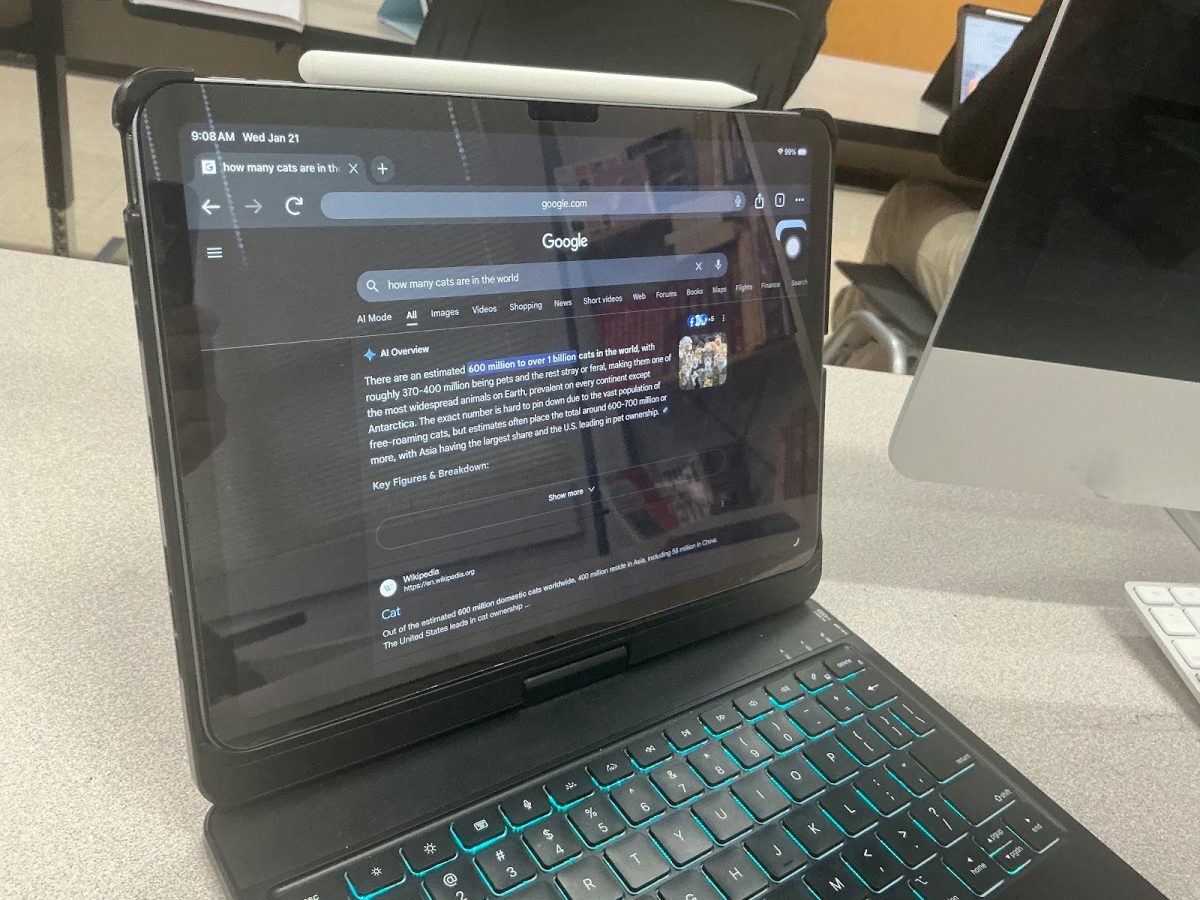

In recent years, more teenagers are turning to artificial intelligence as a solution to their problems ranging from advice and communication, to image generation or homework help. What many people don’t realize, though, is that AI has serious harmful effects on not just people’s minds, but the environment around us.
MHS media conducted a poll of 37 freshmen. According to this poll, up to 78% of these students use some amount of artificial intelligence in their daily lives.
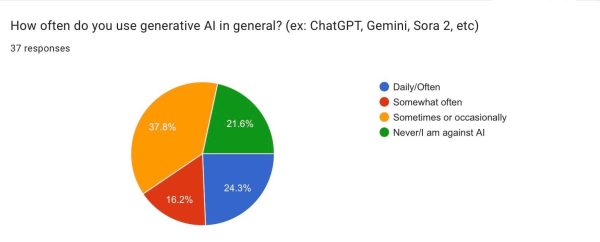
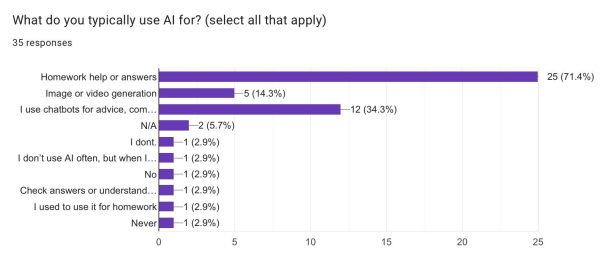
The poll also suggests the majority of these students use AI for either homework assistance or for advice/communication.
To be honest, I have also used AI for homework help in the past, especially in middle school. AI has never really helped me learn the topic, though. I’d do well on the homework, but I did poorly on the tests, because I relied on it for answers instead of help.
Additionally, AI can be misleading or outright false at times. It isn’t the same as talking to a human, as AI is designed and programmed by companies that often prioritize how many people are using their chatbot over how ethical their practices are.
Many AI chatbots, like ChatGPT’s infamous GPT-4o update, often generate responses that are overly agreeable and flattering in order to satisfy the user by telling them what they want to hear, instead of what is actually truthful or correct.
AI can also “hallucinate,” which means it generates responses that, while presented as something logical, are completely incorrect or nonsensical.
Both common flaws in AI chatbots are extremely harmful when it comes to those who use them for advice or connection, spreading misinformation and risking harm on people with potential mental health issues.
One more major issue with AI is its serious risk on the environment around us. According to the Institute of Energy and the Environment, in 2023, data centers consumed up to 4.4% of U.S. electricity. It’s also stated that this number could even triple by 2028.
0Our environment has been at risk due to pollution, energy usage, carbon emissions, and more for years now. If you care about these environmental issues, AI and the energy it uses should also be a concern to you.
With all of these risks and consequences from using AI, it begs the question: Is using AI worth it? Do the quick homework answers, shallow advice, and (oftentimes) poorly generated images matter more than the risk to the environment?
Unfortunately though, AI definitely isn’t going anywhere any time soon, especially with the increasing number of websites integrating AI in some way, shape, or form.
While it’s impossible to go back to a time where AI didn’t exist (at least, in the form it’s in now,) we can do what we can to minimize the amount of times we use it ourselves.
Just like decreasing your carbon footprint, you can do your best to use AI as little as possible in your daily life.